When Diplomacy Goes Quiet: Inside the Final Hours of the Iran–U.S. Negotiations
Public signals are fading while expectations shift toward escalation, indicating a transition from pressure diplomacy to strategic decision-making.

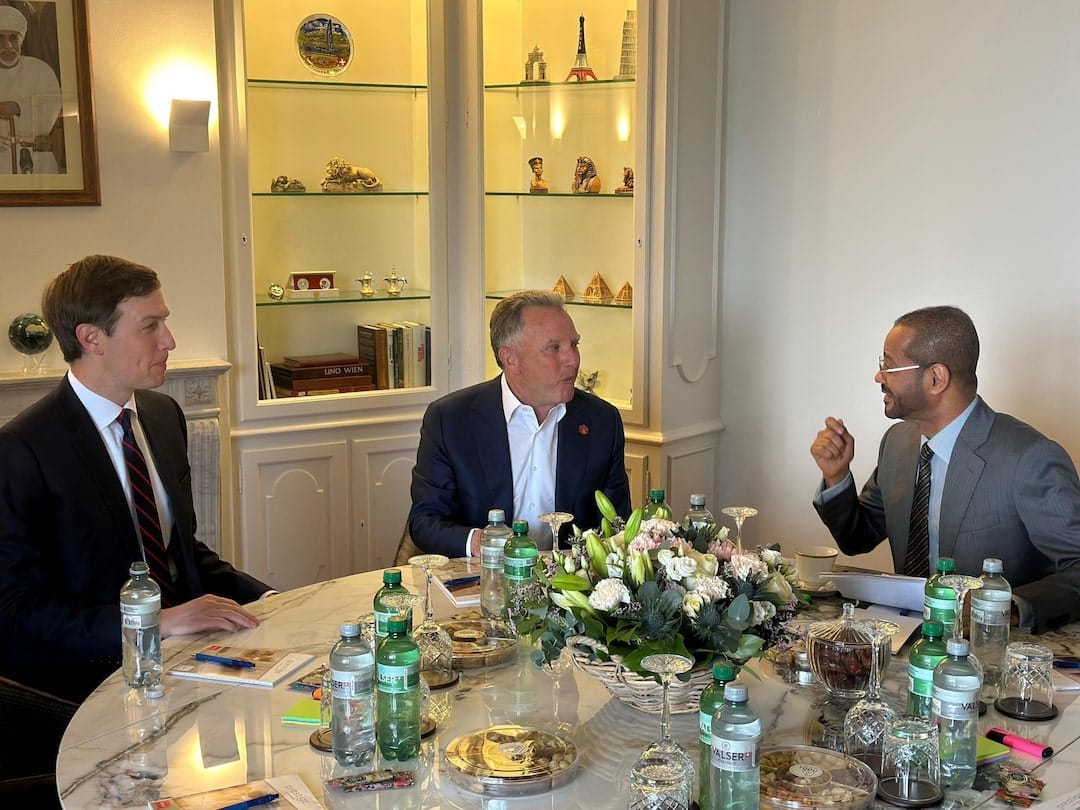
U.S. envoy Steve Witkoff and Jared Kushner meet Omani Foreign Minister Badr al-Busaidi during indirect U.S.–Iran negotiations in Geneva, February 2026. Photo: Omani Ministry of Foreign Affairs / AP
The latest round of Iran–U.S. negotiations entered an unusual pause at midday in Geneva, with talks scheduled to resume around 5:30 PM local time. Iranian representatives announced that they needed to “consult Tehran,” a phrase commonly used in high-stakes diplomacy when negotiators lack authority to accept or reject proposals without direct political approval from the leadership at home.
Following these consultations, Tehran publicly declared that it rejected several of Washington’s core demands. Under normal circumstances, such a public rejection would signal an imminent breakdown. Instead, negotiations resumed in the evening as planned — a development that surprised many observers and suggested that both sides still see value in keeping diplomatic channels formally open, even as positions harden.
While the talks continued behind closed doors, the broader regional signaling shifted noticeably. Israeli officials began warning that military action is increasingly likely. Reports emerged that Israeli hospitals were preparing for the possibility of sustained hostilities lasting weeks rather than days — a precaution typically associated with expectations of missile retaliation rather than limited border escalation. At the same time, reports indicated that the U.S. naval facility in Bahrain reduced staffing to essential personnel, a step often taken to minimize exposure of non-critical staff ahead of potential regional escalation. Hezbollah in Lebanon and the Houthis in Yemen are widely expected to become involved in any confrontation, expanding the risk from a bilateral crisis into a multi-front regional scenario.
In contrast, Washington has grown conspicuously quiet. After months during which U.S. officials publicly commented on nearly every Iranian move, there has been no immediate or forceful reaction to Tehran’s rejection of key demands. This silence stands out precisely because it breaks the earlier pattern of constant public messaging.
Historically, such quiet periods often emerge when diplomacy stops shaping events and military planning begins to take precedence over negotiation theater. During earlier phases, governments communicate actively — issuing warnings, leaks, and public statements designed to influence the opponent’s calculations, reassure allies, and prepare domestic audiences. Once discussions reach a decisive point, however, excessive public messaging can constrain decision-makers or reveal operational intentions. Communication therefore narrows, and messaging discipline increases.
A typical escalation sequence frequently follows a recognizable pattern:
1. Loud signaling phase — public warnings, visible military movements, and extensive media messaging intended to apply pressure.
2. Pause and consultations — delegations return to capitals for political authorization as proposals reach their limits.
3. Reduced public messaging — fewer statements as governments finalize options and contingency plans.
4. Sudden outcome, usually without gradual buildup - either a breakthrough diplomatic announcement, or a limited military strike designed to reset deterrence.
The current absence of strong new U.S. public reactions may therefore be meaningful in itself. Washington has historically limited commentary at moments when operational or strategic decisions are being finalized, preferring ambiguity over escalation through rhetoric.
Taken together, the developments of the past hours suggest that the situation may be entering a quiet decision phase following weeks of highly visible signaling. In such moments, the flow of information often decreases precisely because real choices — diplomatic compromise or military action — are being weighed at the highest levels.
If this pattern holds, the next major signal is unlikely to arrive gradually through incremental news leaks. Instead, it will probably appear suddenly: either as an announced negotiating framework that stabilizes the situation, or as an abrupt operational move that confirms diplomacy has reached its limit.
Recent statements from senior Israeli officials further reinforce this interpretation. Remarks such as “If it remains this way, there is no chance there will be an agreement” are not typical negotiation messaging intended to pressure the other side. Rather, they function as expectation management. When officials speak in these terms while talks are still formally ongoing, the audience is no longer the negotiating partner but domestic publics and allied governments. Such language prepares societies for the possibility of escalation, signals alignment assessments to partners, and helps justify contingency measures that may already be under preparation. In practical terms, it suggests that Israel increasingly assesses diplomatic failure not as a risk, but as the most probable outcome.
An equally significant indicator is the emerging reporting that senior U.S. intermediaries — including figures associated with previous negotiation channels such as Witkoff and Kushner — are leaving the process visibly frustrated. Diplomatic frustration leaks rarely occur by accident. They usually appear when proposals presented at the table fall below minimum strategic requirements, particularly on core issues such as enrichment permanence or the removal and supervision of enriched uranium stockpiles. The consultation pause earlier in the day appears not to have produced meaningful convergence. Negotiations may continue procedurally in order to avoid formal collapse, but the range of acceptable outcomes is narrowing rapidly. Historically, when envoys begin signaling disappointment publicly, talks are entering their terminal bargaining phase — the final stage before either compromise or rupture.
Taken together, these developments suggest a transition from the earlier signaling phase into what might be described as a decision-buffering phase. Public rhetoric decreases, expectations are quietly adjusted, and governments position themselves politically and militarily for whichever outcome emerges. The purpose is not to influence negotiations anymore, but to absorb the shock of the decision that follows.
If this assessment proves correct, the present calm should not be interpreted as stabilization. Rather, it may represent the short interval between visible diplomacy and irreversible action — a moment when negotiations continue in form, but decisions are already approaching their point of execution.
They are negotiating some more weeks until Iran is able to send enough missiles in an instant ( thanks to China and Russia and their own production) to destroy Israel 🙏🔥🙏🔥That will be the final battle between good and evil 🙏🔥🙏🔥✡️🇮🇱🕎🙏🔥🙏🔥🙏🔥🙏Only the Creator can bring Order and Peace to the whole world and HE WILL SOON 🙏🔥❤️ David Melech Yisrael Chai Vekayam 🙏🔥❤️